Showing posts with label suicide. Show all posts

Thursday, July 12, 2018

starlight, I will be chasing a starlight until the end of my life... our hopes and expectations, black holes and revelations

Thursday, 07/12/18, 2:59pm EDT

Apologies for the long absence. I can blame travel for some for it (which I am yet again doing), and having kids home with me for a bunch of time over their summer vacation so far. "A bunch" as in a lot more than I'm used to, not "a bunch" compared to other people out there. But then to give some perspective, "a bunch" more than others out there as well.

I actually wrote a longish draft about a month ago but never finished it and thereby never published it. This has happened before. If it gets to be long enough after writing the beginning of a post, I lose that momentum, that thought train, and it all doesn't make much sense to me anymore to bother attempting to finish it. Eh. That draft was written towards the end of that one biggish suicide week- the one with Kate Spade's suicide, Anthony Bourdain's suicide, and the release of that CDC report about the increase in suicide rate throughout the US since 1999. It was a tough week, emotionally, as suicide discussion is always difficult for me. And then, just in writing the above, I couldn't remember Anthony Bourdain's name, so I was searching through some list of notable people who have committed suicide in the 21st century, and I came across Robin Williams' name from his suicide in 2014, which had escaped my memory. And then there was just the scary length that list was. So now I'm just feeling all the feels again, as usual, of how badly I wish we could get a better handle/abatement/ or just something on mental illnesses and general wish people have of no longer existing. It just... sucks.

But. That isn't the topic I wanted to discuss today.


I want to discuss failure.

It’s something I'm quite certain I’ve brought up before, in varying degrees and contexts, but… failure.

Failure.

Failure is something that has been a really big deal in my head and I’ve continually striven to “not be a failure” which has meant I must somehow be “perfect” (since that’s the opposite?). I think a lot of my depressive thoughts have centered around “I am a failure”:

“I am a failure as a mom”,
“I am a failure because I became a mom so young”,
“I am a failure because I got pregnant out of wedlock”,
“I am a failure at using my engineering degrees”,
“I am a failure at fighting my depression”,
“I am a failure because my depression treatment finally brought me to requiring Electro-Convulsive Therapy this past year”,
“I am a failure at integrating into my life all the things I’ve learned from therapy and depression reading/research and discussions and advice from others”,
“I am a failure at staying in shape”,
“I am a failure because I’ve gained a bunch of weight in the last 2 years”,
“I am a failure because I don’t fit into the clothes I used to”,
“I am a failure because I can’t run a mile without taking walking breaks and without my feet screaming at me”,

“I am a failure because……….”

Everything. Anytime, anywhere, always. Despite that big list, it’s only the tip of the iceberg; I really could go on and on. But you really don’t want to read more than that list, you probably didn’t want to read that long of a list, and I really don’t want to continue because I also know that it could just send me down the hole when here I am, trying to write stuff to keep me out of the hole and maybe even, if possible, help others to not go down that hole.

I went to Catholic schools 1st through 8th grades, switching schools halfway through due to a move we made. Which as a side note, sucks for having to make new friends, you know?

Anyway, I was pretty smart (maybe still am, who knows?), in particular at math. In first grade I was doing second grade math. I can’t actually remember if this event happened in first grade or second, but one of the times I left my classroom to join the next grade’s math, while my class continued working on whatever it was we had been working on (because this is how it was done. Someone from the other class would come to say they were ready for me to join in, and other stuff was done in my classroom. Because apparently this special case they made for me wasn’t really done before? And maths were not taught at the same times? anyway…), apparently while I was gone, the teacher made an announcement to the class to not bring the assignment home to finish because she was concerned we’d all leave the work at home. Well of course I never heard this announcement. And of course I was learning the other math while everyone else could work on this assignment so I had to bring it home in order to work on it and catch up. And then guess what happened? Yup, you guessed it… I left my assignment at home. Because what else would a child of 6 or 7 have done? So then the next day when I told the teacher I’d left my work at home (and I wasn’t smart enough apparently, or at least not learned in the ways of standing up for myself, to say that I hadn’t been in class when she gave that announcement), she really brought me to understand how badly I messed up. And the typical punishment at that time was to put kids to stand in corners (cuz somehow that made sense??). Well I ended up in a corner behind the teacher’s desk. And then she forgot about me. And it still didn’t occur to me to stand up for myself, but I ended up there for way longer than I should have. And I stood there, silently crying. Eventually I was taken out of my punishment, but somehow any memory of the teacher making any apology doesn’t seem to exist; all I remember is the other details in rather exact perfection.

And needless to say, after that school year I decided I wouldn’t go learn the next year’s math anymore because it just wasn’t worth that kind of humiliation and that kind of crushing my spirits and that kind of origin or reinforcement of this idea that I’ve messed up/I’m a failure.

In high school and college I think I felt really good because I thrived so well academically. In high school I was always in accelerated/ advanced placement classes, I got the highest possible score on every one of the advanced placement exams I took earning me college credit. Then in college I studied mechanical engineering, which challenged me, but I guess I rose to the challenge. I did well, I graduated after four years, with one of the semesters being away and working as a co-op, and with internships for each of the summers. I even graduated “with honors” aka magna cum laude or one of those things. I’m not saying all this to brag, but to try and make out what it all has been through my life, what has been my measure of whether or not I’m a failure at that particular bit of my life. I guess I understand a little as to why I put such importance on the academic stuff, even if I don’t think it was the healthiest, especially considering how I think that attitude has probably contributed some/a lot to my current mental health issues which really manifested post kids. I’ve had some additional schooling (with my master’s degree) and some working, but I’ve felt like I haven’t done nearly enough, and I don’t feel remotely capable of going back into it, especially since the ECT treatment has destroyed so much memory. But then I don’t at all feel “enough” as a mother and continually feel like a failure there in my interactions with my kids, and I see all the other mothers around me and compare myself with them and I see how much they are able to accomplish while I can barely do anything especially when I’m constantly doing things for my mental health (and failing at that in the process).

Ok, so let’s try some different things out that don’t focus on the failure stuff so much. Oi. This sounds hard and sounds like I’m already setting myself up for failure.

Deep breath.

Listen a bit to that fantastic music running through my earbuds right now.

Remember a few things…
I love my children.
I love my husband.
I love my family and friends.
I love all those out there who struggle, with the same or similar stuff/thoughts, or with completely different mental or physical or just daily stuff.
I love… myself. (despite how badly I want to add “I think” to that statement)

Now a few more things…
from my bracelets given to me by two wonderful supportive people in my life…

“YOU ARE ENOUGH”
“You Are Braver Than You Believe Stronger Than You Seem And Smarter Than You Think”

I try to wear these bracelets almost every day, because even if I don't sit there and read them multiple times a day, or even when I really should read them as a reminder when I'm down, I think the process of putting them on in the morning is a little uplifting reminder thing that then is just part of my day. And those continuous, habitual reminders can make an enormous difference and very much help in the long run (as I believe research shows but I am too lazy at the moment to look it up and provide links).

Some more things to remember...
I try very very hard, in everything I do, in all the different roles I play in my life, as a wife, as a mother, as a family member to many, as a friend to many.
I try very hard to make the world a slightly better place, particularly in my role as a person who struggles with mental illness and has come to some capability of sharing my personal experiences with others.
I love others around me with my whole heart, even when I don't speak to them very often, even when they live far away or I hardly ever see them, even when they only have been part of my life for a short bit of time a long time ago. I love, very much.
I try to be a good person, to care about people and the world and the earth.


There are some therapies I'm considering trying out to work through some of this "I am a failure" stuff that I continually come back to. Because it is still a bit too ingrained than this post or my lists will really fix. Don't get me wrong, I think this stuff helps and will help and is very worth doing. I just think I need more help that just this.

I would love to get to a point in my life when I can truly discuss this failure stuff, or really all my mental health stuff, without feeling a bit triggered by the discussion. Without wanting to just sit down and sob. Although maybe the fact that I feel these things and yet continue to try and discuss it all with others and share my story is almost even more of an encouragement for others to get there? I don't know. I guess I'm trying to say that I want it to be easier to talk about but also not get to a point where I'm distant or disengaged with it all.

I want everyone out there to be able to recognize the need for help, to feel able/capable/free to seek the help they need, to be free of those feelings of failure that come with seeking help. I want our society, our world, to accept that all people need to feel supported in their lives, in their feelings, in their struggles. Hah, I want that perfect world, rather than that failure of a world I so often feel we're living in. But I guess we do have to continue to strive for the highest possible, without that full connotation of perfection, but maybe just general improvement, so that we don't just keep going at the level we're at. We are not failures, we don't live in failure, but there is always something to keep doing, to keep trying for, to keep improving.

Saturday, October 21, 2017

this is the sound of all of us, singing with love and the will to trust

Saturday, 10/21/17, 12:54pm

I felt the first twinges of depression when I was a pre-teen, middle school/ junior high -ish age. I can't remember exactly. I do remember that I felt lots and lots of suicidal thoughts then. It was often, probably almost continuous, and something I didn't tell a single other soul at the time. I simply thought I was screwed up, I was wrong and different, and I certainly was nowhere near normal.

Today I felt a rush of those feelings I felt as a pre-teen come back from a video I watched. It was this amazing 7th grader delivering a poem she had written about the societal pressures on girls and coming to terms with "you are good enough". It's worth a watch.


In watching her poem, I was reminded of how alone and wrong and awful I felt at that age. I was reminded of how, when my hormones calmed down or whatever, in high school and college, I pretended like that part of my life had never happened. I still didn't talk about it, I still had no idea how I had "gotten over it" or whatever, and I probably just embraced the stinking stigma even more. Perhaps it's part of the reason my depression hit so hard the second time around. Perhaps it's part of the reason I was/am treatment-resistant.

My mother-in-law is in town this weekend, this is Adam's mother of course. She has become even more involved with NAMI and such since Adam's death, and she was telling us about this NAMI conference she went to in Chicago this past week. She attended the keynote on suicide prevention and was telling us about what she'd learned. It was so... touching/moving/tear-jerking to hear about some of these things that are known and taught and are, from my experience of feeling suicidal at many points in my life, so right on. She talked about how the biggest deterrent for people from acting on their thoughts is thinking they won't succeed. (So true).

She also talked about a man who spoke to them about having survived a suicide attempt of jumping off the Golden Gate Bridge, I think one of the ones in this story.

Here's the video of the one man telling his story, also worth a watch (whew, personally sobbed through this one, big time, but again worth.the.watch.):


Sorry, dear readers, that this is such a heavy, heavy blog post. It's important stuff though, stuff that I think I tend to gloss over more often than not. And even though I'm doing so, so much better than I was just a few short months ago, it doesn't mean that all of this is gone. The depression that hit about a week and a half ago was hard. And not devoid of these thoughts. I think that I had had these really high expectations, since "getting better" from ECT, these expectations that I'd never feel the "I want to die" thoughts again. And maybe that's why it hit as hard as it did that day. Because I had convinced myself that I'm too much better for those thoughts.

I don't really know what recovery totally looks like. I know that I have a lot more good days than bad these days, LOTS more. So I consider that recovery. I know that typically when depression hits now, it's not as hard as it used to be. So I consider that recovery. But I guess it probably doesn't mean that it will never hit as hard as it used to. And that can still mean recovery.

I've never acted on the "I want to die" thoughts. I've never cut myself, or attempted suicide. I suppose that doesn't mean that I never will, despite the recovery. But surrounding myself with people who love and support me helps, and keeping up with mindfulness/meditation activities helps, and seeing my therapist and psychiatrist regularly helps, and continuing to find new and extra ways to help helps. The battle never really ends, and I can never really be, well, off my guard.

But that can still mean recovery. And I can still revel in that.

To finish, some fall colors from yesterday's run attempt, which turned into a walk to finish. And some yardwork to get ready for the big town compost pickup this morning. And TK's last soccer game.

Oh and one more thing. Today is World Singing Day, which we didn't attend the event in Boulder for it today, but I still hold it dear in my heart. I am not doing choir this year, because of treatment and getting better and all that, but I do miss it in so many ways, and I miss regularly singing, even though I've picked it back up for boys' bedtimes again more recently.


Sunday, September 10, 2017

I used to think there is no future left at all

Sunday, 09/10/17, 11:57am, 4:44pm

Did you know that today is World Suicide Prevention Day? There's a decent chance you didn't. It's not as recognized as many other days throughout the year, thanks to mental illness being brushed to the side so often. And thanks to the overwhelming stigma when it comes to mental illness. But that page I linked to is very worth reading, especially if you've ever thought that you have no idea what to do to help someone who might be suicidal. Their theme this year, "Take a minute, change a life" is spot on in my opinion, as someone who has dealt with these feelings at multiple points in her life.

This weekend was... tough for me again. Even though I just had treatment last Wednesday. Although we did some looking through Daylio, the daily app I use to track my mood. It seems, that at least this summer, since I started using the app more regularly, I don't do as well on the weekends, for some reason. We're thinking it's probably most to do with the fact that we have less routine on the weekends, and I probably do better with more routine. So I could probably figure out a way to add more routine into the weekends; I was talking today with my sisters about adding more exercise into my life as well, but that could be an easy routine thing to add to the weekends. Maybe a yoga dvd or the exercise bike, if I'm still under 24/7 supervision requirement and can't leave the house. Although... Nasser found out on Friday from some of the ECT people that we could potentially start relaxing some of the 24/7 stuff. It's not much, but little things, like I could stay in the house by myself while Nasser takes the boys to the park, assuming he thinks I'm doing well enough in that current situation. I still can't drive of course, but this is still a big stuff forward. But the exercise stuff is definitely something I need to think about incorporating into my life more. I've been walking more, mostly with my mom, some with my brother-in-law, but I'm thinking I need to get more in, get closer to the level of activity I was at some time ago. I certainly haven't ran in a long time, there was no possibility of a triathlon this summer, and I'd definitely like to get back to that at some point again. Bike-riding, at some point, would be good, so maybe getting on the exercise bike more regularly right now would be good so that I'm more ready for the real thing when I do go off the 24/7 thing. I know that exercise helps me, a lot, so I just need to work on getting it more into my life again.

So what I haven't mentioned is what the next treatment gap is going to be. The last one was 9 days, and I had wondered about that and thought that we'd have to do less this time around. The doctor noted my bad days, but noted that I had an upswing again, still before treatment, and was pleased to see that. So we decided to schedule 2 possibilities again, but this time 9 days and 12 days, so we've got one scheduled for this coming Friday and one the following Monday. So I may end up skipping a week. But we'll see, of course. I had these not so great 2 days, but this week may be better again.

I hope.

I dunno that I really have anything else to talk about. Short post for today. I'll finish with a picture of Nasser and me on the merry-go-round on Friday night at the amusement park we were at- it was for a private work party for the company my sister, brother, and brother-in-law work at.

Tuesday, December 27, 2016

it could be worse

Tuesday, 12/27/16, 1:15pm

Sometimes a day hits that feels nearly impossible to get through. Sometimes it's a few days in a row. And sometimes it feels like months.

These last many months have been very difficult. Adam died in May, which sucked and still sucks and will always suck to whatever extent. We've been changing medications around since like September, which hasn't been going all too well.

Nasser and I have been talking about my depression, and the course of it over the several years. Certain things about it have never felt acceptable, considering the treatment options out there, and the treatments I've tried, both medicinally and therapeutically. The level of low that I get, like intensity, the frequency of my lows. We've tried to look back on the various medications I've attempted and said to ourselves, "maybe that one did work better than I remember." To be honest, it's probably more me that's been doing this than us. I think Nasser would prefer that we look less at the past and keep trying to move forward.

I've been feeling super ashamed about my depression lately all the time. I thought it was helping me to be more honest about it, like with the blogging, but it's also super difficult and sometimes oftentimes just hurtful towards myself. I expect, or wish, for my depression to be treated more like physical illnesses. I expect people to be forward about their support, and many are. But the overwhelming silence is hard. That's the place that breeds me coming up for reasons for why that is. Do people just see me as the weak idiot who can't control her emotions, which is what I fear about myself constantly? Maybe responses of "get over it" and "stop feeling sorry for yourself" aren't any better since those totally accept the stigma that it's all my fault.

The effing stigma. The effing self-stigma. It's like depression, and especially suicide, would be less prevalent without the stupid effing stigma. And most people out there don't get it. If there's less stigma, how do those thoughts of "I'm just a burden to everyone around me" breed anyway? I really wonder what would happen to our world if we all stopped stigmatizing those with an illness, mental or physical?

Just. Fuck. Sometimes, it's just fuck. The world is fuck. The stigma is fuck. This day is fuck.

Excuse my language. Had to get that out though.

Also on top of the effing depression today, there's the sad business of people dying. Like Carrie Fisher. Ugh. Death sucks.

Tuesday, October 4, 2016

we’re broken in two from the day we are born, but you’ll not hear any more of this said

Tuesday, 10/04/16, 8:10am, 12:05pm, 1:25pm

I know I've gone off my soap box several times throughout the course of this blog about the stigma around mental illness and the effects that it has on people with it- here, here, and here for example. But until stigma around mental illness is gone from this world (something I don't expect to happen in my lifetime let alone my kids'), I will continue to talk about it, to bring it up and shine light to it.

I've posted this before, but I think it's worth re-visiting. When I googled "stigma", here's what came up:
stig·ma
ˈstiɡmə/
noun
  1. 1.
    a mark of disgrace associated with a particular circumstance, quality, or person.
    "the stigma of mental disorder"
    synonyms:shame, disgrace, dishonor, ignominy, opprobrium, humiliation, (bad) reputation
    "the stigma of bankruptcy"


Note, the first example is "the stigma of mental disorder". That's because it is SO prevalent. You don't believe me? Read here and here. Why do I think that stigma is still present? Because people still treat mental illness different from physical illness. They assign a shame around mental illness, making the illness his/her fault.

I've stated some of the statistics before, but what does stigma look like?

Stigma is the wave of embarrassment when you talk about crazy Uncle Louie who suffers from biopolar disorder or cousin Steve's crazy ex wife who suffers from schizophrenia. Stigma is shifting your eyes away from the homeless person you see on the corner, mumbling to themselves. Self-stigma is the refusal to seek treatment when you suffer from a mental illness because you think you should be "strong enough" without it. Stigma is when Donald Trump can suggest that military service members who commit suicide do so because they "can't handle it".

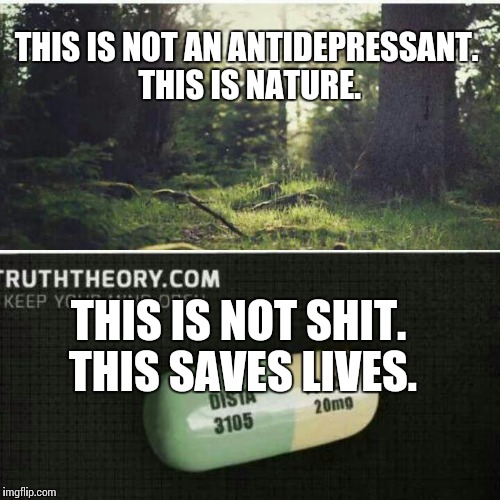
Stigma is this internet meme (there's a part of me that doesn't even want to post it, to give it any notoriety).


Oh that meme makes me so angry (and trust me I know the benefits of the outdoors and I recognize that antidepressants are far from perfect), now I've gotta post the correction meme to this.


The thing is antidepressants can mean that difference between suicidal and not for many people, for some they may take the edge off, for others they might not help much and the side effects may make it not worth it. And then of course for some, they can cause suicidal thoughts, so I agree, when that happens, they're shit. But it isn't fair to discount all the good they do for so many people. And it isn't weak to take medication, it doesn't mean that someone "can't handle it"; it simply means that person has chosen to medically treat their brain. Just like you would with any other organ.

I hate the stigma, I hate my own self-stigma. It makes my depression that much more difficult to battle. I'm fighting that stigma, continually, and I will as long as I'm on this earth. I fight the stigma everytime I write openly about my struggles, I fight the stigma when I request or accept help from others, I fight the stigma when I raise my kids to believe a mental illness is an illness not a character flaw.

Tuesday, September 6, 2016

all I really want is some comfort, a way to get my hands untied

Tuesday, 09/06/16, 9:31am

I don't really want to blog right now. I'm not in the mood for it, but I feel the need to somehow.

The main reason I need to blog, is I found a NAMI blog post, shared on facebook, that really resonated with me. The author writes about "smiling depression", which
 
involves appearing happy to others and smiling through the pain, keeping the inner turmoil hidden. It’s a major depressive disorder with atypical symptoms, and as a result, many don’t know they’re depressed or don’t seek help. People with smiling depression are often partnered or married, employed and are quite accomplished and educated. Their public, professional and social lives are not struggling. Their façade is put together and accomplished. 

But behind the mask and behind closed doors, their minds are filled with thoughts of worthlessness, inadequacy and despair. They’ve usually struggled with depression and/or debilitating anxiety for years and have had some experience with therapy or medication. Many don’t disclose their depression due to fear of discrimination from loved ones or employers. “Oftentimes, I am the only person in this individual’s immediate circle who is aware of how he or she is feeling on the inside,” said Dina Goldstein Silverman, Ph.D., a licensed psychologist and assistant professor of psychiatry."

The entire blog post is worth the read, but this is important because Silverman says "there's a troubling connection between smiling depression and suicide."

I wouldn't really say that I suffer from "smiling depression", anymore, because I've become so open about my depression with others, but maybe I still do to some extent. In person, I will talk about my depression more often than I used to, but oftentimes I will hide it with others, if I'm feeling those feelings and I'm forced into a social situation. This can happen when we travel with others, for ski vacations, camping, family trips, visiting friends or family. If I'm constantly around other people for a weekend for example, I will typically have at least one depressive breakdown, maybe a half hour to a couple hour event usually taking place while hiding with Nasser in the privacy of our bedroom, and then "recover" enough to go be social and happy with the others. I won't usually discuss what happened, even though others may know I've been crying by looking into my eyes. Really I bottle those feelings up for the moment. And it forces me into some resemblance of "recovery", only I don't think it really makes me any better in the long run.

I've been backing out on social engagements more lately, and I think it comes across as "doing badly" or I have "worsened depression". But I don't think that's what it is. Since being more open with my depression in the blog, and as well as on facebook recently, I feel more authentic. And honestly, I'm less interested in being social right after a depressive breakdown because I don't know how yet to be truly authentic (and emotionally safe) with everyone I know when I'm in that state. How can I know that really? We shame "bad feelings" or "moods" so much, that we instinctively hide it when we're around others. Or at least I do. And I'm not interested as much in pretending to be "better" when it's just a façade and a temporary recovery. I do it, still, plenty often, but I'm learning to be more authentic with those I trust. I will talk about my depression and share about my most recent depressive breakdown at a party or family get-together, because I'm trying to be authentic.

It's been hard for me to know how to respond lately when people ask "how are you doing?". When it's someone I don't know, like at the grocery store, I still say "fine, how are you?" or something along those lines. But when it's someone I know, and I assume now that they know I have depression and they may or may not read my blog, I want to be more authentic. And no, actually I'm not really fine. I haven't been "fine" in a long, long time. Like truly fine, like consistently fine. Maybe it's only been since Adam's death, or maybe it's been since my depression really manifested 8.5ish years ago.

And we continue to work on it, as we've done since I first started treatment. I've been on several different medications and am now working on a new one, I've been doing therapy consistently for a long time, I've read (some) books and many articles on ways to help depression, I've blogged, I've discussed it at length with friends and family, I've cut out alcohol to very rare occasions, I've been working on affirmations, I practice mindfulness and I recognize the important of exercise and eating right on my overall health. I have put and continue to put so much effect into "not being depressed".

And I still. get. depressed.

I think that will always be the case, but all I can do is to continue doing the things I do. I continue to try to be better, to limit the depression as much as possible, and to cut myself slack when it hits or when I'm going through tough things like changing medications.

And it's ok. I will always continue working on the things that are shown to help, I will continue trying new things (even if I'm slow to start them, because there are still emotional hurdles to overcome with these), and I will continue to seek the support of others and try not to feel guilty over it.

We're going to end this post with some affirmations now.

I am strong. I am loving. I am capable. I am compassionate. I am brave. I am loved. I am nurturing. I am supported.

I am absolutely NOT a failure.

I dare greatly, at least sometimes.

And I continue.

Tuesday, August 23, 2016

teach your parents well... and feed them on your dreams

Tuesday, 08/23/16, 11:24am

I've gone back and forth on what exactly is my diagnosis. To be honest, I've never truly had a doctor independently diagnose me. I've always come to them and said, I have depression. A lot of the diagnosis is self assessment anyway. It really makes mental healthcare confusing.

I suppose in most cases, people present fairly clearly as having depression, or schizophrenia, or bipolar disorder, or obsessive-compulsive disorder, or anxiety, or alcoholism. But when you have multiple things going on and a variety of symptoms, everything gets a little murky.

I know that I often exhibit signs of depression as well as anxiety, although probably with fewer occurrences of anxiety. I spent some time reading definitions in Wikipedia and WebMD about these, but haven't felt all too satisfied with how everything is categorized. Even reading technical definitions of what is categorized as a "depressive episode" is a bit triggering.

I need to stop here and correct something that I've been writing for some time. I've been referring to "depressive episodes" for quite some time, here, here, and here, for example, but I've had the technical definition wrong. For me, what I've been calling depressive episodes, I'm going to start referring to as depressive breakdowns. For me, it's any time where I have debilitating feelings of worthlessness types of feelings which prevent me from being the person I want to be. Sometimes these events can affect me for half an hour and then I can recover (but that's rare and I think some of those times are the start of anxiety attacks, with some crying to relieve the buildup of stress). But sometimes these events affect me for an evening or a whole day or several days.

Here's the actual definition of a depressive episode, courtesy of WebMD:

An episode of depression involves feeling sad or blue, or getting no pleasure from life, plus at least five or more of these additional symptoms most of the day -- nearly every day -- for two weeks or longer:
  • Loss of energy
  • Feelings of guilt, hopelessness, or worthlessness
  • Loss of interest or enjoyment from things that were once pleasurable
  • Difficulty concentrating
  • Low energy
  • Feeling physically or mentally sluggish or restless and agitated
  • Increased need for sleep or inability to sleep (insomnia)
  • Change in appetite causing weight loss or gain
  • Thoughts of death or suicide or attempting suicide

My therapist pulled out the DSM definition yesterday so we could discuss it together. I certainly present many of these signs when I'm feeling depressed, and some often, but I don't really meet that time criteria
regularly. So I suppose I don't really have chronic major depression. But maybe chronic depression (without the major) is more correct? That doesn't seem to be a true scientific term.

It's probably another discussion I should have with my psychiatrist.

Regardless, whether or not I have major depression or minor depression or some anxiety, a lot of the treatment is the same. It makes sense for me to be on an anti-depressant and to have some anti-anxiety medication for when it's needed, and it makes sense to be seeing a therapist regularly to work on cognitive behavioral therapy because that's been shown to help with both depression and anxiety, and it makes sense to be practicing mindfulness and exercising because again they help with both.

So does the exact diagnosis matter? No, but I do apologize for messing up the verbiage I use sometimes. I will try to start referring to depressive episodes correctly and will start to use my own non-scientific terms perhaps.

Today I ran for just under a mile with my littlest running buddy, TK. He started kindergarten but only goes every other day (for 2.5 days of each week), so he is home today.


We also prepped apples together and there is some applesauce cooking in the crockpot. (As much as it looks like he is about to cut off his fingers here, there were no casualties. And at least it's a special kid knife that's not nearly as sharp as our regular ones).

And since I'm on a picture kick, we have some nice ones of the first day of school yesterday, both before,

and after school.


2.5ish more hours until we get RG from the bus. Gotta be done with the blog and get moving on lunch, maybe some puzzles and practicing the alphabet, and perhaps a shower.

Sunday, August 21, 2016

on a stormy sea of moving emotion, tossed about, I'm like a ship on the ocean, I set a course for winds of fortune

Sunday, 08/21/16, 3:44pm

It feels like I've been fucking up for the last several months. Most especially, since the tragedy of Adam's death. Since then, everything has felt off, everything I've done has felt like a failure, and I've personally let down several people in my life, maybe.

I feel like I'm shirking responsibility for my own life by putting this all in perspective of Adam's death. But I have been rather affected by it. I've talked about this at length in the past, but the grief isn't magically gone now that more than 3 months have gone by. I feel like some of it has been delayed and pushed away at times.

This summer, despite some great travels, has been hard. We've needed more our little family time and less social obligations. We've needed more downtime, more allowances for messy house/screen time/fewer activities. But now we're trying to get ourselves back to normal, since the school year kinda requires us to. And it's hard.

RG was sick this week and he actually missed the first two days of school. It was a real bummer and definitely threw me off a little since I had much different expectations for those days. But being a good "take care of my kid when he's sick" mom helped improve some of my self-confidence.

I'm starting to wonder about changing my meds right now. There's also several other changes happening in my life too: kids are starting up school again, TK in kindergarten, we'll be in a new routine, I'm going to have some more free time to get in exercise and therapy appointments, and I'm also trying to get back into practicing mindfulness. It's hard to ever have a more controlled experimentation of medications, but it's so hard to reduce all the variables. It's not like I want to avoid getting back into an exercise routine right now in order to remove that as a variable. It's possible that I will be getting much better in the next few weeks due to all theses other changes, and not necessarily the medication.

It just makes treating mental illness that much more difficult, accounting for all the variables.

Did you know that Adam's death certificate lists (not sure if it still does since there was some family effort to change it) the cause of death as "suicide"? It's probably easiest to label it that and I'm sure they saw "schizophrenia" and figured there really is no other thing to list since it was probably, at least in part, caused by his mental illness. I've gone back and forth on what I think happened, and I think we all probably do. I think I have to not call it suicide, for my own sanity and because of my own fears for my self in my lowest of lows. But sometimes those thoughts creep back in of maybe it was suicide and we didn't see the signs because he was good at hiding that part. It's possible. With mental illness, it seems like there's so much of hiding from other people.

I understand why we hide our struggles, and there are so many reasons to do so. For one, we don't want to worry those that love us. But I think there's this big part of it that is perpetuated by the stigma of mental illness. We don't want others to look at us as "crazy" or "weak" or "mentally unstable". We don't want to be seen as a failure because we aren't able to just overcome the illness.

I think it's critical to be more open about our struggles in order to receive the best treatment. We have to be honest with our care providers, our doctors, and our therapists, but we also have to be honest with those who can support us, those who care about us. I think the support network thing is a huge component of the treatment, and yet the pressure to keep these things silent prevents getting all the support we need.

We had a surprise birthday party for my sister and her husband in celebration of their 40th birthdays (a month apart from eachother). It was a success, although I still feel awful over the people we forgot to invite, or didn't have email addresses for, etc. I did another specialty cake, this time to honor their love of skiing.

The backstory here is even though they are both normally skiers, my sister is snowboarding because now that she's 40, she feels ready to try new things. :) Finding skier figurines in August did not prove to be an easy task.

Although I mostly just got pictures of the cake, I got a few of us getting ready to surprise them.


I haven't been social much lately, mostly due to recent sickness, my depression, the grief, social anxiety, and some Nasser stomach troubles. But last night was nice, it was the right setting for me, the right people, to feel supported through it all. Unfortunately Nasser and TK were sick yesterday (probably from whatever RG had), so that made for a more stressful day, but the success of the party was enough to make me feel more normal last night.

Wednesday, May 4, 2016

don't let yourself go, everybody cries and everybody hurts sometimes

Wednesday, 05/04/16, 9:58am, 12:32pm,

I'm watching my nephew for much of the day today, and yet it's almost easier to attempt to blog when TK has a playmate. We'll see if I can fit it all in. What I have to blog about today has been on my mind for some time and requires some extra thought and planning. It's a topic I don't want to mess up.

What I have to discuss is suicide. It's not on my mind because of anything specific to me, but NPR has done a slew of articles about it recently and it's really caught my attention. They've reported on suicide in the Native Arctic communities in Greenland where the suicide rate is the highest in the world (here's a spoiler: they don't think it's due to the darkness), and they did a followup with questions from listeners and readers here. They talked about suicide rates climbing in the U.S., particularly among female adolescents. PRI reported on the CDC's investigation of a cluster of teen suicides in Palo Alta.

It's hard to read about suicide. I'm not going to deny that. But I think it's great that the media is sparking some conversations about it. It's something that we as a society feel shame to talk about yet it's so important to do so. I strongly feel that the best way to confront the issues of mental illness and suicide and substance abuse is to talk about them and keep working towards ways to improve outcomes (which you can't figure out unless you talk about it), with legislature to follow the best we know based on research. More on that another day. Today I want to start the discussion about suicide.

NPR had one article on "How Do You Help Someone Who Is At Risk Of Suicide?". I thought it was pretty well done. I think I expected more from the title of the article than it gave. But there are some useful things it included which I'll paste below, hmmm, maybe it's most of it. For some background, NPR talked with Dr. Jill Harkavy-Friedman of the American Foundation for Suicide Prevention and Dr. Jitender Sareen of the University of Manitoba, both psychiatrists, about what is known about youth suicide and best practices for preventing suicide. The article follows a question and answer format.

"In Greenland the highest rate of suicide is among young people between ages 15 and 25. How does that compare with the U.S. and worldwide?

Dr. Jitender Sareen: In native communities here in Canada and in the U.S., unfortunately young people have a much higher risk of suicide — often five or six times as high as the general population. Men commit suicide more often than women — that's true almost everywhere. [Although it's unclear why this is, it may be related to access to weapons or greater impulsiveness.] We've also seen instances where multiple young people enter suicide pacts, and there can be a contagion effect especially among youth. The underlying issues that lead to those crises are related to lack of basic things like clean water, housing and jobs. A lot of young people are impoverished and do not see any path to a good future.

Dr. Jill Harkavy-Friedman: It's also important for people to understand that suicide is not native to any culture. It's what happens to people when they're in situations of increased stress. So the high rate of suicide in Greenland, for example, doesn't say anything inherent about the culture. Actually, in the United States and most places, the highest-risk group for suicide are middle-aged [people] and the elderly. Fortunately, teen suicide rates in the U.S. are significantly lower, though teen suicide is still of concern.

Are there specific things a parent or friend should say — or not say — to a young person who they believe is potentially suicidal?
Harkavy-Friedman: If you're worried about somebody, ask. It's a little scary to ask, and you don't start off with, "Are you thinking about suicide?" You want to base your questions on what you've seen and what you notice. Like, "You seem very down lately and you're not with your friends. Is something going on? Are you feeling OK?" or "You look kind of sad. Are you?"

Then the next step is to just listen to what they have to say and try to really hear them, and interact with them so they know you've heard and understood. These are not quick-fix problems, so even though as parents and friends we want to say, "Just snap out of it!" or "It's not that big a deal!" to that person at that time, it is a big deal.

Sareen: In Native communities, one thing we've found is that messages that are based in culture are often more effective, but culturally sensitive communication is complicated. You can't assume that everyone in Native or First Nations has the same Native culture. For example, some Native people may feel cut off from their traditional culture and religion, while others are practicing Christians, and you need to remember that when you talk to them about their problems. This is one challenge for researchers and doctors who want to help in Native communities. Before you can help, you have to build a trusting relationship and understand the place, which can take years.

What if the person you're worried about doesn't want to talk?
Harkavy-Friedman: It's not uncommon, particularly with teens, that they don't want to talk. Or, they don't want to talk to you. If you're the parent, for instance. The key is that there may be somebody they can talk to, and it's not a time to stand on ceremony and say, "You must talk to me because I'm your parent." Find somebody they do feel comfortable talking to, and try to help them engage with that person.

Is it ever dangerous to ask someone about suicidal thoughts?
Harkavy-Friedman: Talking about suicide with someone will not make them suicidal. In fact it will make people feel better more typically, because they're holding [painful feelings] inside, and when you ask them, that's an opportunity to address it and problem-solve and feel better. So you're not going to make someone suicidal if you say, "Are you feeling like you want to kill yourself?" Talking to someone really helps; we have data to show that.

Is there such a thing as talking too much about suicide?
Harkavy-Friedman: It's not so much that a person can talk too much or too little. It's more about talking to someone who can help versus someone who can't. If you're talking to someone who can help you, then it's good. And, unlike maybe even 20 years ago when there was nothing available and no one was talking about teen suicide, now there are lots of tools and interventions available.

Sareen: I would say there is a balance when you're talking to teenagers, especially in very small towns. What we're facing, often, in the small communities is there's almost too much talk about suicide. When a suicide happens, in a larger community you might not hear about it, but in very small communities youth are kind of exposed to suicide and there's a lot of talking about it. It may inadvertently positively reinforce suicidal behavior. An overresponse of the media and overresponse of the community can actually lead to a clustering effect. That's one of the challenging parts of making suicide more publicly discussed ... that youth might see it as a way to escape their difficulties."


I have such a hard time with the last part, that talking about suicide and giving it exposure can "inadvertently positively reinforce suicidal behavior". I can see why that would be but we need to figure out if there are specific ways we can report it that wouldn't do that. I think talking about suicide too much with a higher-profile death, Robin Williams for example, could lead to a clustering unfortunately, but I really don't have anything to back that up other than what my gut says. My gut says that talking about it in a manner that NPR and PRI have been doing lately is the right way to do it. I don't feel like they're glamorizing suicide in any way, and they're presenting the facts, the issues, the statistics. I feel unsatisfied in most of these articles in regards to what's currently being done about these issues. I don't think that's a failure in the articles; I think that's a failure in society. Suicide isn't a high profile "cause" for most people unless they've been personally affected by it. But then there's the added societal stigma that comes with mental illness and suicide, and no one wants to talk about it.

The one unifying theme that I've found in suicide research, it's the idea that suicide is preventable. I also want to recognize that we should be careful when saying that because that can cause shame and guilt in survivors, those who have lost loved ones to suicide. Many things can help prevent suicide though: the support network looking for warning signs is probably number #1, medications, therapy treatment just to name a few. We should be doing all we can to prevent suicide considering how "preventable" it is. 

I've said before that I don't really consider suicide to typically be a "selfish" act, although I know that's a common belief. The reason is, when I've felt "suicidal" (and there are degrees of "suicidal" ranging from thoughts of helplessness and hopelessness to planning and attempting. I've been on various points on the scale in the past, typically much closer to the safer end and I've never attempted.), the "reasons" (however irrational) for my thoughts are that everyone would be better off without me, I'm a horrible person. It's selfish in the sense that it's very centered around the self, but it's not selfish in the sense of "I don't care about anyone else", etc. I don't know who's right when it comes to it, but I think it's important to educate yourself on what suicidal feels for a person, before making judgments on them. It always come back to trying to empathize with others. Putting yourself in their shoes, trying to understand the thoughts and fears and struggles other people have. I'm not going to go on an empathy rant again, I've done that before, But, if you haven't yet seen the Brené Brown cartoon clip on empathy, you should watch it now. Or re-watch it.

I guess my biggest thing about helping someone who may be suicidal, if they're willing to talk to you about it, please just be open and empathetic (NOT sympathetic) in your conversations with them. It is not your job to tell the person that their thoughts and emotions are irrational or that they should "snap out of it" or that it's not a big deal. Those kind of comments can have the opposite effect. Instead you can say things like "that sounds hard" or "I'm sorry you're going through that" or "is there any way I can help?". And please please don't take offense if a friend or loved one doesn't wish to talk with you about it. It takes an incredible amount of vulnerability to open up to someone about this kind of "tough stuff" (although I do think it gets easier with practice), and sometimes the fear that it will hurt more than help can close people off. All you wonderful support people out there, it usually takes a lot of patience, and understanding, and again, empathy.